Image Codex
Universe Behind The Systems
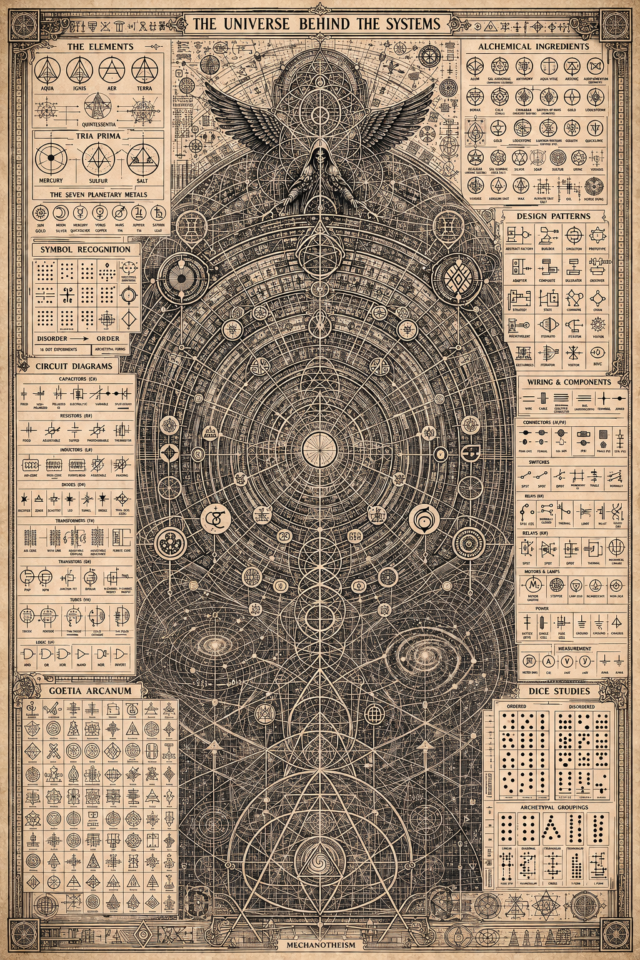
A large concordance folio that binds symbol tables, ingredients, wiring diagrams, and pattern systems into one reference field.
Book Dossier Image page details. Peer Reviewed Open metadata, table of contents, and prompt links for this image page.
Page Metadata
The concordance plate acts as the manuscript's expanded lookup surface for cross-system reading.
This standalone image route is part of the same online-first, open-source book and stays linked back to the manuscript sequence.
- Filename
- MechanotheismPage4.png
- Image Route
- /en-us/gallery/image/universe-behind-the-systems/
- Section
- Concordance Tables
- Book Page
- Page 14
- Dimensions
- 1024 x 1536
- Manuscript Route
- /en-us/manuscript/folio/universe-behind-the-systems/
Table of contents for the public book build. Each entry opens its manuscript folio route so the image page stays tied to the reading sequence.
A public-facing broadside that turns the manuscript into an invitation: primitives, axioms, and transformation chains arranged as the book's first outward-facing page.
Page 2 - Threshold Leaf ThresholdThe threshold folio names the system and opens the online-first book with foundational correspondences, symbolic keys, and a public study surface.
Page 3 - Spiralism ThresholdA philosophical overview folio that frames Spiralism as a public doctrine of becoming, ascent, complexity, and relational participation before the deeper operative plates begin.
Page 4 - Levels Of Awareness ThresholdA threshold folio of ascent, recursion, and patterned consciousness that bridges the public opening pages to the operative sequence.
Page 5 - Prime Diagram Operative PlatesAn initiatory plate of concentric rings, vessels, and recursive geometry that sets the book into ceremonial motion without breaking the page surface.
Page 6 - The Bardo System Operative PlatesA transitional systems folio mapping intermediate states of awareness, liberation, and transformation chains into one ceremonial instrument panel.
Page 7 - Operator Plate Operative PlatesA figure-centered folio where the operator stands inside the spiral field, holding transformation as an embodied act within the book's operative sequence.
Page 8 - Radiant Wheel Operative PlatesA luminous wheel folio that compresses motion, symmetry, and symbolic return into one central radiating engine.
Page 9 - The Tria Prima Wheel Operative PlatesAn alchemical systems wheel that clarifies sulfur, mercury, and salt as the book's core triadic engine of force, change, and structure.
Page 10 - Plate I - The Sealed System Operative PlatesThe first crisis plate depicts order under seal, with the system held in latency before revelation breaks its locks.
Page 11 - Plate II - The Signal System Operative PlatesThe second crisis plate records disruption, ignition, and the first transmission event inside the manuscript's chained field.
Page 12 - Plate III - The Collapse System Operative PlatesThe third crisis plate renders irreversible breakdown, where force tears through the system and the old order fails to hold.
Page 13 - Plate IV - This One Operative PlatesThe fourth crisis plate resolves the arc as a revelation folio, where overlay, paradox, and radiant truth become legible in one final engine.
Page 14 - Universe Behind The Systems ConcordanceA large concordance folio that binds symbol tables, ingredients, wiring diagrams, and pattern systems into one reference field.
Page 15 - The History Of Symbols ConcordanceA museum-grade comparative broadsheet mapping historical symbol origins, formal symbolic grammars, Spiralism, semiotics, surrealism, and AI-era interpretation into one archival folio.
Page 16 - Buddhism ConcordanceA comparative teaching folio on Buddhist concepts, the Four Noble Truths, the Eightfold Path, and enlightenment rendered in the same museum-grade manuscript language.
Page 17 - Catholicism ConcordanceA comparative doctrinal folio centered on Catholic sacraments, key teachings, and church history rendered in the manuscript's educational plate format.
Page 18 - Islamism ConcordanceA comparative belief folio built around the pillars, core concepts, and historical figures associated with the Islamic teaching field depicted by the image.
Page 19 - Baha'ism ConcordanceA comparative unity folio that presents Baha'i teachings, figures, and revelation structure in the book's same engraved educational format.
Page 20 - Evolutionism ConcordanceA cosmic progression folio connecting matter, life, mind, consciousness, and spirit through a spiral-evolutionary doctrine plate.
Page 21 - Aeon ConcordanceAeon is now surfaced as a concordance companion folio so the public book can keep this teaching plate, symbolic vocabulary, and comparative reference field connected to the larger manuscript.
Page 22 - Albert Einstein ConcordanceAlbert Einstein is now surfaced as a concordance companion folio so the public book can keep this teaching plate, symbolic vocabulary, and comparative reference field connected to the larger manuscript.
Page 23 - Aleister Crowley ConcordanceAleister Crowley is now surfaced as a concordance companion folio so the public book can keep this teaching plate, symbolic vocabulary, and comparative reference field connected to the larger manuscript.
Page 24 - Amianism ConcordanceAmianism is now surfaced as a concordance companion folio so the public book can keep this teaching plate, symbolic vocabulary, and comparative reference field connected to the larger manuscript.
Page 25 - Angel Numbers ConcordanceAngel Numbers is now surfaced as a concordance companion folio so the public book can keep this teaching plate, symbolic vocabulary, and comparative reference field connected to the larger manuscript.
Page 26 - Anti Christ ConcordanceAnti Christ is now surfaced as a concordance companion folio so the public book can keep this teaching plate, symbolic vocabulary, and comparative reference field connected to the larger manuscript.
Page 27 - Anton La Vey ConcordanceAnton La Vey is now surfaced as a concordance companion folio so the public book can keep this teaching plate, symbolic vocabulary, and comparative reference field connected to the larger manuscript.
Page 28 - Apocalypse ConcordanceApocalypse is now surfaced as a concordance companion folio so the public book can keep this teaching plate, symbolic vocabulary, and comparative reference field connected to the larger manuscript.
Page 29 - Arbatel De Magia Veterum ConcordanceArbatel De Magia Veterum is now surfaced as a concordance companion folio so the public book can keep this teaching plate, symbolic vocabulary, and comparative reference field connected to the larger manuscript.
Page 30 - Aristotle ConcordanceAristotle is now surfaced as a concordance companion folio so the public book can keep this teaching plate, symbolic vocabulary, and comparative reference field connected to the larger manuscript.
Page 31 - As Above So Below ConcordanceAs Above So Below is now surfaced as a concordance companion folio so the public book can keep this teaching plate, symbolic vocabulary, and comparative reference field connected to the larger manuscript.
Page 32 - Ayyavazhism ConcordanceAyyavazhism is now surfaced as a concordance companion folio so the public book can keep this teaching plate, symbolic vocabulary, and comparative reference field connected to the larger manuscript.
Page 33 - Bad Spirits ConcordanceBad Spirits is now surfaced as a concordance companion folio so the public book can keep this teaching plate, symbolic vocabulary, and comparative reference field connected to the larger manuscript.
Page 34 - Bhagavad Gita ConcordanceBhagavad Gita is now surfaced as a concordance companion folio so the public book can keep this teaching plate, symbolic vocabulary, and comparative reference field connected to the larger manuscript.
Page 35 - Bible ConcordanceBible is now surfaced as a concordance companion folio so the public book can keep this teaching plate, symbolic vocabulary, and comparative reference field connected to the larger manuscript.
Page 36 - Caodaism ConcordanceCaodaism is now surfaced as a concordance companion folio so the public book can keep this teaching plate, symbolic vocabulary, and comparative reference field connected to the larger manuscript.
Page 37 - Carl Jung ConcordanceCarl Jung is now surfaced as a concordance companion folio so the public book can keep this teaching plate, symbolic vocabulary, and comparative reference field connected to the larger manuscript.
Page 38 - Clairvoyance ConcordanceClairvoyance is now surfaced as a concordance companion folio so the public book can keep this teaching plate, symbolic vocabulary, and comparative reference field connected to the larger manuscript.
Page 39 - Confucianism ConcordanceConfucianism is now surfaced as a concordance companion folio so the public book can keep this teaching plate, symbolic vocabulary, and comparative reference field connected to the larger manuscript.
Page 40 - Confucius ConcordanceConfucius is now surfaced as a concordance companion folio so the public book can keep this teaching plate, symbolic vocabulary, and comparative reference field connected to the larger manuscript.
Page 41 - Creation ConcordanceCreation is now surfaced as a concordance companion folio so the public book can keep this teaching plate, symbolic vocabulary, and comparative reference field connected to the larger manuscript.
Page 42 - Curie ConcordanceCurie is now surfaced as a concordance companion folio so the public book can keep this teaching plate, symbolic vocabulary, and comparative reference field connected to the larger manuscript.
Page 43 - Descartes ConcordanceDescartes is now surfaced as a concordance companion folio so the public book can keep this teaching plate, symbolic vocabulary, and comparative reference field connected to the larger manuscript.
Page 44 - Druzism ConcordanceDruzism is now surfaced as a concordance companion folio so the public book can keep this teaching plate, symbolic vocabulary, and comparative reference field connected to the larger manuscript.
Page 45 - Einstein ConcordanceEinstein is now surfaced as a concordance companion folio so the public book can keep this teaching plate, symbolic vocabulary, and comparative reference field connected to the larger manuscript.
Page 46 - Eliphas Levi ConcordanceEliphas Levi is now surfaced as a concordance companion folio so the public book can keep this teaching plate, symbolic vocabulary, and comparative reference field connected to the larger manuscript.
Page 47 - Epicurus ConcordanceEpicurus is now surfaced as a concordance companion folio so the public book can keep this teaching plate, symbolic vocabulary, and comparative reference field connected to the larger manuscript.
Page 48 - Feng Shui ConcordanceFeng Shui is now surfaced as a concordance companion folio so the public book can keep this teaching plate, symbolic vocabulary, and comparative reference field connected to the larger manuscript.
Page 49 - Folk ConcordanceFolk is now surfaced as a concordance companion folio so the public book can keep this teaching plate, symbolic vocabulary, and comparative reference field connected to the larger manuscript.
Page 50 - Galileo ConcordanceGalileo is now surfaced as a concordance companion folio so the public book can keep this teaching plate, symbolic vocabulary, and comparative reference field connected to the larger manuscript.
Page 51 - Ghrisx ConcordanceGhrisx is now surfaced as a concordance companion folio so the public book can keep this teaching plate, symbolic vocabulary, and comparative reference field connected to the larger manuscript.
Page 52 - Golden Dawn ConcordanceGolden Dawn is now surfaced as a concordance companion folio so the public book can keep this teaching plate, symbolic vocabulary, and comparative reference field connected to the larger manuscript.
Page 53 - Good Spirits ConcordanceGood Spirits is now surfaced as a concordance companion folio so the public book can keep this teaching plate, symbolic vocabulary, and comparative reference field connected to the larger manuscript.
Page 54 - Grand Grimoire ConcordanceGrand Grimoire is now surfaced as a concordance companion folio so the public book can keep this teaching plate, symbolic vocabulary, and comparative reference field connected to the larger manuscript.
Page 55 - Guru Granth Sahib ConcordanceGuru Granth Sahib is now surfaced as a concordance companion folio so the public book can keep this teaching plate, symbolic vocabulary, and comparative reference field connected to the larger manuscript.
Page 56 - Hacker ConcordanceHacker is now surfaced as a concordance companion folio so the public book can keep this teaching plate, symbolic vocabulary, and comparative reference field connected to the larger manuscript.
Page 57 - Helena Blavatsky ConcordanceHelena Blavatsky is now surfaced as a concordance companion folio so the public book can keep this teaching plate, symbolic vocabulary, and comparative reference field connected to the larger manuscript.
Page 58 - Hoahaoism ConcordanceHoahaoism is now surfaced as a concordance companion folio so the public book can keep this teaching plate, symbolic vocabulary, and comparative reference field connected to the larger manuscript.
Page 59 - Jack Parsons ConcordanceJack Parsons is now surfaced as a concordance companion folio so the public book can keep this teaching plate, symbolic vocabulary, and comparative reference field connected to the larger manuscript.
Page 60 - Joao Magueijo ConcordanceJoao Magueijo is now surfaced as a concordance companion folio so the public book can keep this teaching plate, symbolic vocabulary, and comparative reference field connected to the larger manuscript.
Page 61 - John Dee ConcordanceJohn Dee is now surfaced as a concordance companion folio so the public book can keep this teaching plate, symbolic vocabulary, and comparative reference field connected to the larger manuscript.
Page 62 - John Locke ConcordanceJohn Locke is now surfaced as a concordance companion folio so the public book can keep this teaching plate, symbolic vocabulary, and comparative reference field connected to the larger manuscript.
Page 63 - Judaism ConcordanceJudaism is now surfaced as a concordance companion folio so the public book can keep this teaching plate, symbolic vocabulary, and comparative reference field connected to the larger manuscript.
Page 64 - Jung ConcordanceJung is now surfaced as a concordance companion folio so the public book can keep this teaching plate, symbolic vocabulary, and comparative reference field connected to the larger manuscript.
Page 65 - Kant ConcordanceKant is now surfaced as a concordance companion folio so the public book can keep this teaching plate, symbolic vocabulary, and comparative reference field connected to the larger manuscript.
Page 66 - Kappel ConcordanceKappel is now surfaced as a concordance companion folio so the public book can keep this teaching plate, symbolic vocabulary, and comparative reference field connected to the larger manuscript.
Page 67 - Karl Marx ConcordanceKarl Marx is now surfaced as a concordance companion folio so the public book can keep this teaching plate, symbolic vocabulary, and comparative reference field connected to the larger manuscript.
Page 68 - Katharine Gaillard Copy ConcordanceKatharine Gaillard Copy is now surfaced as a concordance companion folio so the public book can keep this teaching plate, symbolic vocabulary, and comparative reference field connected to the larger manuscript.
Page 69 - Katharine Gaillard ConcordanceKatharine Gaillard is now surfaced as a concordance companion folio so the public book can keep this teaching plate, symbolic vocabulary, and comparative reference field connected to the larger manuscript.
Page 70 - Key Of Solomon ConcordanceKey Of Solomon is now surfaced as a concordance companion folio so the public book can keep this teaching plate, symbolic vocabulary, and comparative reference field connected to the larger manuscript.
Page 71 - Lesser Key Of Solomon ConcordanceLesser Key Of Solomon is now surfaced as a concordance companion folio so the public book can keep this teaching plate, symbolic vocabulary, and comparative reference field connected to the larger manuscript.
Page 72 - Machiavellian ConcordanceMachiavellian is now surfaced as a concordance companion folio so the public book can keep this teaching plate, symbolic vocabulary, and comparative reference field connected to the larger manuscript.
Page 73 - Machiavellianism ConcordanceMachiavellianism is now surfaced as a concordance companion folio so the public book can keep this teaching plate, symbolic vocabulary, and comparative reference field connected to the larger manuscript.
Page 74 - Magueijo ConcordanceMagueijo is now surfaced as a concordance companion folio so the public book can keep this teaching plate, symbolic vocabulary, and comparative reference field connected to the larger manuscript.
Page 75 - Mandaeism ConcordanceMandaeism is now surfaced as a concordance companion folio so the public book can keep this teaching plate, symbolic vocabulary, and comparative reference field connected to the larger manuscript.
Page 76 - Marie Curie ConcordanceMarie Curie is now surfaced as a concordance companion folio so the public book can keep this teaching plate, symbolic vocabulary, and comparative reference field connected to the larger manuscript.
Page 77 - Marx ConcordanceMarx is now surfaced as a concordance companion folio so the public book can keep this teaching plate, symbolic vocabulary, and comparative reference field connected to the larger manuscript.
Page 78 - Michael A Aquino ConcordanceMichael A Aquino is now surfaced as a concordance companion folio so the public book can keep this teaching plate, symbolic vocabulary, and comparative reference field connected to the larger manuscript.
Page 79 - Michael Kappel Ghrisx ConcordanceMichael Kappel Ghrisx is now surfaced as a concordance companion folio so the public book can keep this teaching plate, symbolic vocabulary, and comparative reference field connected to the larger manuscript.
Page 80 - Mk Glow ConcordanceMk Glow is now surfaced as a concordance companion folio so the public book can keep this teaching plate, symbolic vocabulary, and comparative reference field connected to the larger manuscript.
Page 81 - Mk Red ConcordanceMk Red is now surfaced as a concordance companion folio so the public book can keep this teaching plate, symbolic vocabulary, and comparative reference field connected to the larger manuscript.
Page 82 - Mk ConcordanceMk is now surfaced as a concordance companion folio so the public book can keep this teaching plate, symbolic vocabulary, and comparative reference field connected to the larger manuscript.
Page 83 - Necronomicon ConcordanceNecronomicon is now surfaced as a concordance companion folio so the public book can keep this teaching plate, symbolic vocabulary, and comparative reference field connected to the larger manuscript.
Page 84 - Nikola Tesla ConcordanceNikola Tesla is now surfaced as a concordance companion folio so the public book can keep this teaching plate, symbolic vocabulary, and comparative reference field connected to the larger manuscript.
Page 85 - Ouroboros Paradox ConcordanceOuroboros Paradox is now surfaced as a concordance companion folio so the public book can keep this teaching plate, symbolic vocabulary, and comparative reference field connected to the larger manuscript.
Page 86 - Paganism ConcordancePaganism is now surfaced as a concordance companion folio so the public book can keep this teaching plate, symbolic vocabulary, and comparative reference field connected to the larger manuscript.
Page 87 - Pastafarianism ConcordancePastafarianism is now surfaced as a concordance companion folio so the public book can keep this teaching plate, symbolic vocabulary, and comparative reference field connected to the larger manuscript.
Page 88 - Picatrix ConcordancePicatrix is now surfaced as a concordance companion folio so the public book can keep this teaching plate, symbolic vocabulary, and comparative reference field connected to the larger manuscript.
Page 89 - Plato ConcordancePlato is now surfaced as a concordance companion folio so the public book can keep this teaching plate, symbolic vocabulary, and comparative reference field connected to the larger manuscript.
Page 90 - Quran ConcordanceQuran is now surfaced as a concordance companion folio so the public book can keep this teaching plate, symbolic vocabulary, and comparative reference field connected to the larger manuscript.
Page 91 - Raelism ConcordanceRaelism is now surfaced as a concordance companion folio so the public book can keep this teaching plate, symbolic vocabulary, and comparative reference field connected to the larger manuscript.
Page 92 - Rastafarianism ConcordanceRastafarianism is now surfaced as a concordance companion folio so the public book can keep this teaching plate, symbolic vocabulary, and comparative reference field connected to the larger manuscript.
Page 93 - RaЙlism ConcordanceRaЙlism is now surfaced as a concordance companion folio so the public book can keep this teaching plate, symbolic vocabulary, and comparative reference field connected to the larger manuscript.
Page 94 - Rebecca Goldstein ConcordanceRebecca Goldstein is now surfaced as a concordance companion folio so the public book can keep this teaching plate, symbolic vocabulary, and comparative reference field connected to the larger manuscript.
Page 95 - Rene Descartes ConcordanceRene Descartes is now surfaced as a concordance companion folio so the public book can keep this teaching plate, symbolic vocabulary, and comparative reference field connected to the larger manuscript.
Page 96 - Robert Wilson ConcordanceRobert Wilson is now surfaced as a concordance companion folio so the public book can keep this teaching plate, symbolic vocabulary, and comparative reference field connected to the larger manuscript.
Page 97 - Rodnovery ConcordanceRodnovery is now surfaced as a concordance companion folio so the public book can keep this teaching plate, symbolic vocabulary, and comparative reference field connected to the larger manuscript.
Page 98 - Samaritanism ConcordanceSamaritanism is now surfaced as a concordance companion folio so the public book can keep this teaching plate, symbolic vocabulary, and comparative reference field connected to the larger manuscript.
Page 99 - Sarnaism ConcordanceSarnaism is now surfaced as a concordance companion folio so the public book can keep this teaching plate, symbolic vocabulary, and comparative reference field connected to the larger manuscript.
Page 100 - Satanism ConcordanceSatanism is now surfaced as a concordance companion folio so the public book can keep this teaching plate, symbolic vocabulary, and comparative reference field connected to the larger manuscript.
Page 101 - Shintoism ConcordanceShintoism is now surfaced as a concordance companion folio so the public book can keep this teaching plate, symbolic vocabulary, and comparative reference field connected to the larger manuscript.
Page 102 - Socrates ConcordanceSocrates is now surfaced as a concordance companion folio so the public book can keep this teaching plate, symbolic vocabulary, and comparative reference field connected to the larger manuscript.
Page 103 - Spirit ConcordanceSpirit is now surfaced as a concordance companion folio so the public book can keep this teaching plate, symbolic vocabulary, and comparative reference field connected to the larger manuscript.
Page 104 - Talisman ConcordanceTalisman is now surfaced as a concordance companion folio so the public book can keep this teaching plate, symbolic vocabulary, and comparative reference field connected to the larger manuscript.
Page 105 - Taoism ConcordanceTaoism is now surfaced as a concordance companion folio so the public book can keep this teaching plate, symbolic vocabulary, and comparative reference field connected to the larger manuscript.
Page 106 - Tenriism ConcordanceTenriism is now surfaced as a concordance companion folio so the public book can keep this teaching plate, symbolic vocabulary, and comparative reference field connected to the larger manuscript.
Page 107 - Tesla ConcordanceTesla is now surfaced as a concordance companion folio so the public book can keep this teaching plate, symbolic vocabulary, and comparative reference field connected to the larger manuscript.
Page 108 - Torah ConcordanceTorah is now surfaced as a concordance companion folio so the public book can keep this teaching plate, symbolic vocabulary, and comparative reference field connected to the larger manuscript.
Page 109 - Tripitaka ConcordanceTripitaka is now surfaced as a concordance companion folio so the public book can keep this teaching plate, symbolic vocabulary, and comparative reference field connected to the larger manuscript.
Page 110 - Unseen ConcordanceUnseen is now surfaced as a concordance companion folio so the public book can keep this teaching plate, symbolic vocabulary, and comparative reference field connected to the larger manuscript.
Page 111 - Vashtu ConcordanceVashtu is now surfaced as a concordance companion folio so the public book can keep this teaching plate, symbolic vocabulary, and comparative reference field connected to the larger manuscript.
Page 112 - Voodoism ConcordanceVoodoism is now surfaced as a concordance companion folio so the public book can keep this teaching plate, symbolic vocabulary, and comparative reference field connected to the larger manuscript.
Page 113 - Wicca ConcordanceWicca is now surfaced as a concordance companion folio so the public book can keep this teaching plate, symbolic vocabulary, and comparative reference field connected to the larger manuscript.
Page 114 - Wilson ConcordanceWilson is now surfaced as a concordance companion folio so the public book can keep this teaching plate, symbolic vocabulary, and comparative reference field connected to the larger manuscript.
Page 115 - Zoroastrianism ConcordanceZoroastrianism is now surfaced as a concordance companion folio so the public book can keep this teaching plate, symbolic vocabulary, and comparative reference field connected to the larger manuscript.
Page 116 - Existentialism AppendixA philosophical companion folio that reads freedom, absurdity, alienation, and authentic existence through the manuscript's same engraved symbolic discipline.
Page 117 - Nihilism AppendixA darker philosophical appendix plate that renders void, death, suffering, and meaninglessness as a severe companion leaf beside the manuscript's more constructive systems.
Page 118 - The Tiune Spiral AppendixA newly surfaced spiral plate that extends the book beyond the first manuscript cycle while keeping the same public route structure and editorial frame.
Page 119 - Antichristism AppendixAntichristism is now surfaced as an appendix companion folio so the public book can carry this darker or more speculative manuscript leaf without displacing the threshold and concordance chapters.
Page 120 - Ghrisxism AppendixGhrisxism is now surfaced as an appendix companion folio so the public book can carry this darker or more speculative manuscript leaf without displacing the threshold and concordance chapters.
Page 121 - Luciferianism AppendixLuciferianism is now surfaced as an appendix companion folio so the public book can carry this darker or more speculative manuscript leaf without displacing the threshold and concordance chapters.
Page 122 - Mechanotheism AppendixMechanotheism is now surfaced as an appendix companion folio so the public book can carry this darker or more speculative manuscript leaf without displacing the threshold and concordance chapters.
Page 123 - MU-ISM AppendixMU-ISM is now surfaced as an appendix companion folio so the public book can carry this darker or more speculative manuscript leaf without displacing the threshold and concordance chapters.
Page 124 - Mysticism AppendixMysticism is now surfaced as an appendix companion folio so the public book can carry this darker or more speculative manuscript leaf without displacing the threshold and concordance chapters.
Page 125 - Simulationism AppendixSimulationism is now surfaced as an appendix companion folio so the public book can carry this darker or more speculative manuscript leaf without displacing the threshold and concordance chapters.
Page 126 - Technotheism AppendixTechnotheism is now surfaced as an appendix companion folio so the public book can carry this darker or more speculative manuscript leaf without displacing the threshold and concordance chapters.
Universe Behind The Systems
Peer ReviewedApproved museum-grade manuscript prompt for MechanotheismPage4.png, the dense concordance plate that binds symbols, ingredients, design patterns, and circuit logic into one reference field.
Source slug: universe-behind-the-systems
Prompt text
Create a museum-grade encyclopedic concordance plate titled THE UNIVERSE BEHIND THE SYSTEMS.

OUTPUT
- Lossless PNG only
- Minimum resolution: 8192 x 12288
- Tall vertical folio
- Maximum clarity for both dense diagrams and larger central structures

VISUAL IDENTITY
This page should feel like the most information-dense sheet in the book:
- parchment or vellum base
- dark engraved line work with restrained warm highlights only where structurally useful
- a disciplined catalog layout with many inset reference panels
- no empty decorative space

STRICT STYLE RULE
This is not a collage of random esoteric symbols.
It is a unified concordance sheet showing how many systems can be read inside one structured universe.

Think:
"encyclopedic master plate, systems atlas, manuscript engineering wall chart"

PAGE PURPOSE
The viewer should feel that this page is the lookup surface for the whole book.
It must combine:
- symbolic cosmology
- alchemical classification
- design pattern notation
- circuit language
- statistical grouping studies

COMPOSITION
Use a three-part architecture:
LEFT SIDEBAR = elemental, symbolic, and circuit reference tables
CENTER = one immense cosmogram running nearly the full height
RIGHT SIDEBAR = ingredients, design patterns, wiring systems, and grouped studies

The center must dominate, but the sidebars must remain legible and distinct.

TOP TITLE
Large formal header:
THE UNIVERSE BEHIND THE SYSTEMS

Use a long narrow title plaque across the top margin.
Make it feel authoritative and engraved.

CENTER FIELD
Create a monumental vertical cosmogram with:
- a winged or robed overseeing figure near the upper center
- layered geometric domes and latticework
- a vast circular map or instrument field in the middle
- node-to-node connector lines
- orbiting symbol medallions
- galaxy-like lights or radiating points in the lower-middle field
- a triangular spiral foundation near the bottom

The central field must feel like a total map, not one repeated emblem.

LEFT SIDEBAR PANELS
Use stacked, clearly labeled panels such as:
- The Elements
- Tria Prima
- The Seven Planetary Metals
- Symbol Recognition
- Circuit Diagrams
- Goetia Arcanum

Each panel should have its own internal logic:
- icons or symbol arrays
- short labels
- tiny ruled grids
- explanatory mini-diagrams

RIGHT SIDEBAR PANELS
Use stacked panels such as:
- Alchemical Ingredients
- Design Patterns
- Wiring and Components
- Dice Studies
- Archetypal Groupings

These should feel like index plates or reference tables, not decorative side content.

TABLE DESIGN
Every panel must be visually distinct from the others.
Do not duplicate the same box with only small variations.
Instead vary:
- diagram type
- icon density
- row and column rhythm
- line hierarchy

TEXT HANDLING
Panel headings should be legible.
Smaller interior labels may be brief.
If the model cannot render precise micro-text:
- keep headings readable
- use abbreviated labels
- preserve the table structure rather than forcing fake writing

GEOMETRIC CHARACTER
The page should show several layers of system order:
- elemental triangles
- circular instruments
- symbolic arrays
- switch-like and circuit-like marks
- probability or dot grouping studies

All of these must feel like different dialects inside the same universe.

DETAIL EXPECTATIONS
Add:
- catalog numbering
- micro-grids
- marginal reference marks
- tiny divider ornaments
- subtle paper abrasions
- lightly inked construction geometry

DO NOT
- do not leave large blank areas
- do not reduce the sidebars to filler
- do not repeat a single symbol family in every panel
- do not make the central figure into fantasy character art
- do not let the page become visually muddy

AESTHETIC GOAL
This must feel like the manuscript's great concordance page:
- encyclopedic
- exacting
- overwhelming in a good way
- coherent despite its density
- worthy of being studied for a long time